
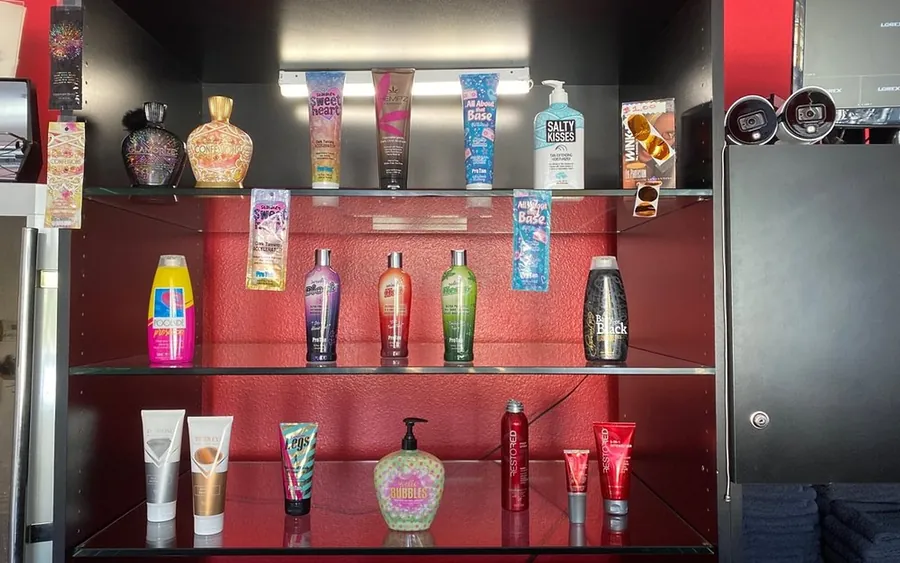
If you've driven along Ramon Road or Date Palm Drive past the strip malls of Cathedral City, you already know this desert doesn't lack for sunshine. But outdoor sun and indoor UV sessions are two different things, and the lotion you pair with your tanning bed or booth matters just as much as the session length. Indoor tanning lotions are formulated specifically for use with UV equipment, not for lounging poolside in Rancho Mirage or hiking the trails near Indian Wells. Before you buy a bottle at any salon counter — including ours — there are a handful of questions worth asking first.
At Guilty Tans in Cathedral City, we get asked about indoor tanning lotions almost as often as we get asked about bed types. That makes sense. The Coachella Valley's dry heat, low humidity, and near-constant sun exposure change how skin behaves compared to more temperate climates, and the right lotion choice depends on your equipment, your skin type, and what you're actually trying to accomplish during your session. This guide walks through the practical side of choosing indoor tanning lotions — what the categories mean, how desert conditions factor in, what to ask at the counter, and where the limits of any lotion actually are.
Why the Equipment Comes Before the Lotion
A common mistake is picking a lotion first and the tanning equipment second. It should be the other way around. The acrylic in a stand-up booth, the lamps in a lay-down bed, and the intensity of a high-pressure system all interact differently with lotion formulas. Some lotions are designed with bronzers or tingle ingredients that behave differently depending on heat and lamp output, and a formula that works well in one piece of equipment may not perform the same way in another.
Before you shop for a lotion, know which equipment you're using. At Guilty Tans, that might mean the Ambition Combination Tanning Bed, the base-building Sonnen Braune Base-Building Tanning Bed, the high-pressure King 420 High-Pressure Tanning Bed, or one of our stand-up units like the Hex Stand Up Tanning Booth or the Saturn High-Pressure Stand-Up Booth. Each piece of UV tanning equipment has its own lamp configuration, and our staff can tell you which lotion types are generally compatible before you spend money on a product that won't perform the way you expect.
If you tend to rotate between equipment — say, a lay-down bed on busy days and a stand-up booth when you're in a hurry — it's worth asking staff whether your current lotion works across both, or whether you need two separate products. This is a common situation for guests who tan a few times a week and want flexibility in scheduling around work or family in Palm Desert or Rancho Mirage.
Types of Indoor Tanning Lotions You'll See on the Shelf
Walk into any salon along Highway 111 and you'll find rows of bottles with names that sound more like energy drinks than skincare. Broadly, indoor tanning lotions fall into a few categories:
- Accelerators — formulated to moisturize and support the skin during UV exposure, often used by people newer to indoor tanning or those just getting back into a routine after time away.
- Bronzers — contain ingredients intended to add visible color on top of the base tan the UV session produces. These vary widely in intensity and ingredient makeup.
- Maximizers — marketed toward people already building a base who want to continue developing color over repeated sessions.
- After-tan or maintenance lotions — used between sessions to keep skin hydrated, which matters a lot here given how fast desert air pulls moisture from skin.
- Cooling or soothing formulas — sometimes used after a session, particularly for guests with sensitive skin who find standard lotions too rich in summer heat.
None of these lotions change the UV exposure itself or make a session "safer." They're skincare products meant to be used alongside your tanning routine, not a substitute for sunscreen when you're outdoors at the Agua Caliente Casino pool deck or running errands down Perez Road in July. The CDC advises avoiding indoor tanning to reduce skin-cancer risk, and no lotion changes that underlying guidance.
Desert Climate Factors That Affect Your Lotion Choice
Cathedral City and the surrounding valley — Palm Springs, Palm Desert, Rancho Mirage, La Quinta, Indian Wells, Indio, Thousand Palms, Desert Hot Springs, and Sky Valley — all share a dry, low-humidity climate that's rough on skin year-round. A few things to keep in mind:
- Dry air pulls moisture fast. Lotions with stronger hydrating bases tend to hold up better here than in coastal climates, where ambient humidity does some of the hydration work for you.
- Chlorine exposure is common. If you're a regular pool user in Palm Desert or Indian Wells communities with shared pools, chlorine can strip skin between sessions, so a maintenance lotion matters more than it might elsewhere.
- Heat changes how lotion feels on skin. A heavier lotion that works fine in a cooler climate might feel uncomfortably rich under Coachella Valley summer temperatures, especially in July and August when daytime highs regularly climb past 110 degrees.
- Seasonal swings matter. Winter in the valley is drier and cooler than summer, and some guests find they prefer a lighter lotion in summer and a richer one in winter months.
- Indoor sessions don't offset outdoor sun. Many valley residents are outside daily — golfing in La Quinta, walking in Desert Hot Springs, or running errands — so understanding your skin type on the Fitzpatrick scale helps you and our staff talk through realistic expectations for both indoor and outdoor exposure.
Building a Lotion Routine Step by Step
If you're setting up a lotion routine for the first time, here's a practical sequence to follow rather than guessing:
- Identify your equipment. Decide whether you'll primarily use a lay-down bed, a stand-up booth, or a mix of both.
- Talk through your skin history with staff. Mention any sensitivities, past reactions, or whether you're new to indoor tanning entirely.
- Start with a single product. Avoid buying multiple lotions at once before you know how your skin responds to one.
- Track how your skin feels after a few sessions. Note dryness, tightness, or any irritation, and bring that feedback back to staff on your next visit.
- Adjust for the season. Revisit your lotion choice as summer heat or winter dryness changes how your skin behaves.
- Separate your maintenance routine from your session routine. A lotion used between sessions to combat dryness is not the same product as one used during a session.
Questions to Ask at the Counter
Here's a practical checklist to bring with you, whether you're shopping at Guilty Tans or anywhere else in the valley:
- Is this lotion compatible with the bed or booth I'm using? Some formulas are made for high-pressure equipment specifically.
- Does it contain a bronzer, and how does that interact with my skin tone? Bronzing ingredients behave differently from person to person.
- Is this a step-up product, or a maintenance product? Know whether you're trying to build color or simply hold onto what you already have.
- What's the hydration profile? Given how dry the air is here, this matters more than it might in a humid climate.
- Are there any ingredients I should avoid given my skin sensitivity? If you have sensitive skin or a history of reactions, say so before buying.
- How should I store it? Heat exposure in a car parked outside in July can affect lotion consistency and shelf life, so avoid leaving bottles in a hot vehicle.
- Does the salon staff have a recommendation based on the equipment I'm using? This is the single most useful question, because staff who work with the equipment daily usually know what pairs well.
What Our Staff Can (and Can't) Tell You
Our team at Guilty Tans can walk you through our indoor tanning lotion selection and explain which products are generally used with which equipment. What we won't do is promise a specific shade, a faster result, or claim that any lotion makes UV exposure safer. It doesn't. Indoor tanning lotion is a skincare product, not a replacement for sunscreen, and it doesn't change the fact that UV exposure carries risk regardless of the equipment or product used.
If you're new to tanning altogether, it's worth reading through our first visit and tanning info page before your appointment so you know what to expect from both the equipment and any lotion recommendations. That page covers logistics like what to bring and how sessions are structured, which pairs naturally with the lotion questions covered here.
Pairing Lotion Routines With Other Services
Some Guilty Tans guests also use our Red Light Therapy sessions as part of a broader skin routine, separate from UV tanning. It's not a tanning method and doesn't replace lotion use during UV sessions, but it's worth asking about if you're interested in options beyond the tanning beds and booths. For a general overview of how sun exposure and vitamin D intersect with skin health, our sun exposure resource page is a good starting point, though it isn't a substitute for talking with a medical provider about your individual health history. Our broader Learn section also covers related topics like vitamin D if you're curious about the bigger picture beyond lotion and equipment choices.
Why Lotion Choice Differs Across the Valley
A tanner coming from Thousand Palms with naturally fair skin is going to have a very different lotion conversation than someone from La Quinta who tans a few times a week to maintain color. Someone driving in from Desert Hot Springs after a day outdoors may need more hydration-focused products than someone just starting out. A guest from Sky Valley who only visits occasionally during cooler months might prioritize a different formula than a regular from Indio tanning year-round. That's part of why we ask about your tanning history and skin type before recommending anything — a one-size-fits-all bottle doesn't exist, no matter how the label reads.
Common Mistakes to Avoid
- Buying a bronzer without understanding how it reacts with your skin tone. Start conservative if you haven't used one before.
- Leaving lotion bottles in a hot car. Desert heat can change the consistency and shelf life of lotion faster than in milder climates.
- Assuming one lotion works for every piece of equipment. What pairs well with a stand-up booth may not be the right choice for a high-pressure bed.
- Skipping the conversation with staff. The product label alone doesn't tell you everything relevant to your specific skin and equipment combination.
- Treating indoor lotion as sunscreen. It isn't, and it won't protect you during outdoor exposure in the valley's intense summer sun.
Budgeting for Lotion as Part of Your Routine
Lotion is a recurring cost, not a one-time purchase, especially if you're tanning regularly. Before you commit to a routine, check our tanning prices page to understand session costs so you can budget lotion purchases alongside your visits rather than as an afterthought. Guests who tan a few times a week often find it easier to plan lotion purchases around their regular session schedule rather than buying reactively.
Frequently Asked Questions
Do I need a special lotion for stand-up booths versus lay-down beds in Cathedral City?
Some lotions are formulated with specific equipment in mind. Ask our staff which products are generally paired with the stand-up booths versus the lay-down beds before you buy, since compatibility can vary by formula and lamp intensity.
Can indoor tanning lotion replace sunscreen when I'm outside in Palm Springs or Palm Desert?
No. Indoor tanning lotions are made for use during UV sessions on specific equipment. They are not sunscreen and don't protect skin from outdoor sun exposure, which matters given how much time valley residents spend outdoors.
How often should I use lotion if I tan regularly in the Coachella Valley?
That depends on your skin, your equipment, and how often you're in the sun outside of sessions. It's a conversation to have with salon staff who know your routine, not a fixed schedule that applies to everyone equally.
Where can I see what lotions Guilty Tans carries?
You can browse our current indoor tanning lotion selection in salon or ask our team during your visit which products pair with the equipment you plan to use.
What should I do if a lotion irritates my skin?
Stop using it and let staff know during your next visit. Mention any redness, tightness, or discomfort so they can help you consider a different formula better suited to your skin's sensitivity.
Is a more expensive lotion always the better choice?
Not necessarily. Price often reflects ingredient complexity or bronzer intensity rather than a guaranteed outcome. The better question is whether the formula suits your skin type, your equipment, and the desert climate rather than the price tag alone.
Visit Guilty Tans in Cathedral City
Guilty Tans has been part of Cathedral City since 2000, and our staff are used to answering lotion questions from tanners across Palm Springs, Palm Desert, Rancho Mirage, La Quinta, Indian Wells, Indio, Thousand Palms, Desert Hot Springs, and Sky Valley. Stop by, bring your questions, check our hours and location, and let our team help you figure out what actually makes sense for your skin and your equipment — no guesswork required.